


Greenwashing fines are no longer a theoretical risk. Between March 2024 and November 2025, a Dutch court ruled KLM’s sustainability ads misleading, Italy fined SHEIN 1 million euros, a Paris court convicted TotalEnergies over its carbon neutrality messaging, and 21 airlines rewrote their climate claims under pressure from the European Commission. All of this happened under laws that already exist. From 27 September 2026, the EU’s EmpCo Directive makes the same outcomes easier to reach, in every sector.
This post walks through the four cases, what each one cost, who did the enforcing, and what a marketing team should change now.
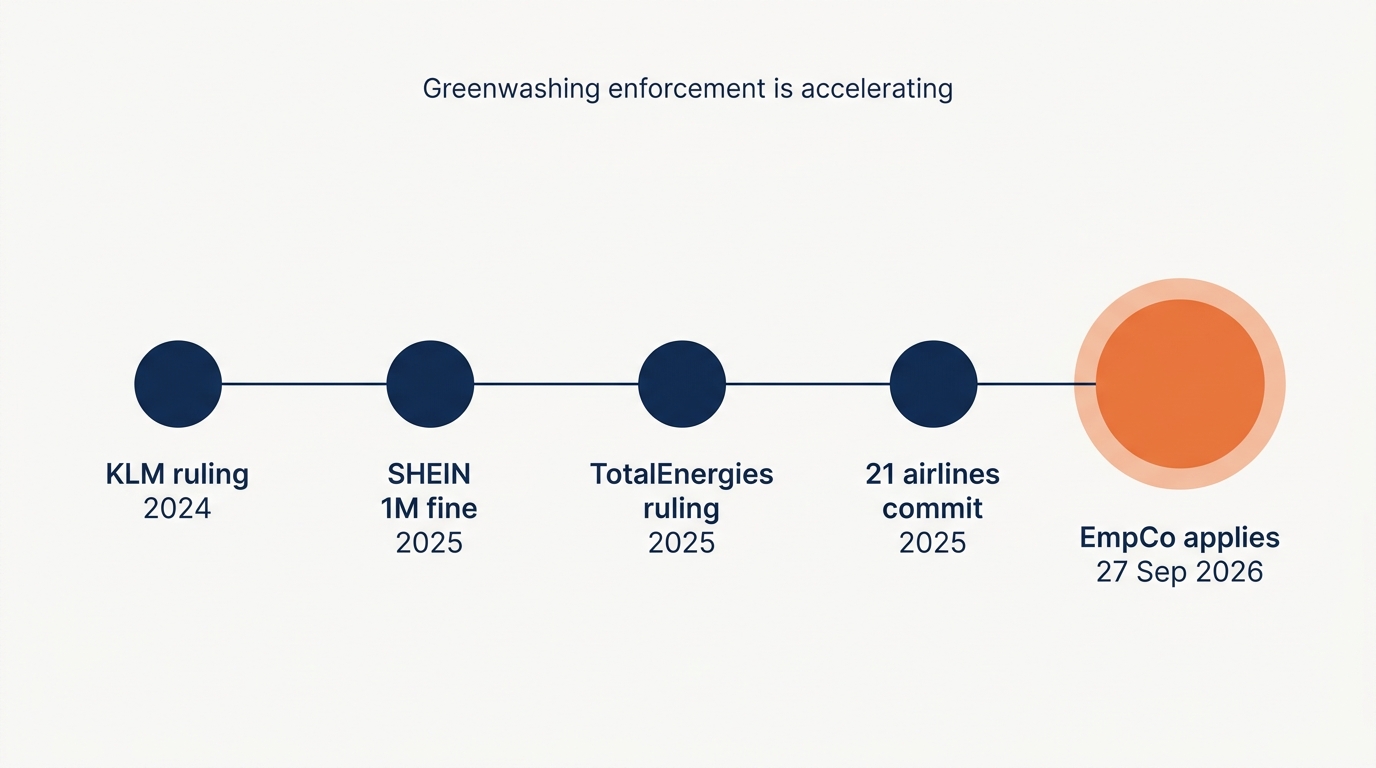
Which companies have been caught for greenwashing?
Four cases from the last two years matter most, because together they show every route enforcement can take: a national court, a national regulator, and an EU-wide sweep.
KLM was the first airline to lose a greenwashing case in court. On 20 March 2024, the District Court of Amsterdam ruled that 15 of 19 challenged ads from the “Fly Responsibly” campaign were misleading. The case was brought not by a regulator but by Fossielvrij, a Dutch NGO. The court found that KLM painted an overly optimistic picture of measures like alternative fuels and reforestation, and that its CO2ZERO offset product wrongly suggested customers could neutralise their flight.
SHEIN received a 1 million euro fine from AGCM, the Italian competition authority, in August 2025. The regulator found the “evoluSHEIN” collection was marketed as recyclable and responsible without disclosing how small a share of production it covered. It also found something more uncomfortable: SHEIN’s public emissions targets did not match the rising emissions in its own reports. The regulator read the company’s marketing against the company’s data, and the gap became the case.
TotalEnergies lost in the Judicial Tribunal of Paris on 23 October 2025, the first greenwashing ruling against an oil and gas major under EU-derived consumer law. The claims at issue were not product ads. They were brand statements on a consumer-facing website: “carbon neutrality by 2050” and “a major player in the energy transition”. The court ordered the claims removed and the judgment published on the company’s own homepage for 180 days. The Columbia Climate Law analysis of the ruling is worth reading in full, because it shows how ordinary consumer law reached a corporate climate strategy.
21 airlines, from Ryanair to the Lufthansa group, committed in November 2025 to rewrite their environmental claims after a coordinated action by the European Commission and national consumer authorities. Per the Commission’s announcement, the carriers agreed to stop claiming that paying extra for offsets or alternative fuel neutralises the emissions of a specific flight, and to make their CO2 calculators transparent. National authorities now monitor whether they deliver.
Click through the case files to compare them side by side:
Four enforcement cases, three routes to a verdict
- The claim
- “Fly Responsibly” ads and CO2ZERO offsets that suggested flying could be made sustainable.
- Who acted
- A class action by the Dutch NGO Fossielvrij before the District Court of Amsterdam.
- The outcome
- 15 of 19 challenged ads ruled misleading in March 2024. The first greenwashing judgment against an airline.
- The lesson
- Vague sustainability framing is a legal claim, not a vibe. Courts read your ads the way a consumer does.
- The claim
- The “evoluSHEIN” collection marketed as recyclable and responsible, plus net-zero targets.
- Who acted
- An investigation by AGCM, the Italian competition and consumer authority.
- The outcome
- A €1 million fine in August 2025. The targets clashed with the company's own rising emissions data.
- The lesson
- Regulators cross-check your marketing against your own reports. Contradictions read as deception.
- The claim
- “Carbon neutrality by 2050” and “a major player in the energy transition” on a consumer-facing site.
- Who acted
- Three NGOs before the Judicial Tribunal of Paris, under consumer protection law.
- The outcome
- Ruled misleading in October 2025. The judgment had to be published on the company's own homepage for 180 days.
- The lesson
- Even aspirational net-zero language counts as advertising. The remedy can be worse than a fine.
- The claim
- Paying extra for offsets or alternative fuel presented as neutralizing the emissions of your flight.
- Who acted
- A coordinated sweep by the European Commission and the Consumer Protection Cooperation Network.
- The outcome
- 21 carriers, from Ryanair to Lufthansa, committed in November 2025 to rewrite their claims under monitoring.
- The lesson
- Sector-wide sweeps exist. A complaint aimed at your industry can land on your marketing.
What do these cases have in common?
The details differ, but three patterns repeat. They are worth internalising, because they describe how the next case will work too.
Your own data is the evidence
SHEIN’s fine did not rest on a lab test or a consumer survey. It rested on the distance between the marketing and the company’s own sustainability reporting. Any brand that publishes an ESG report while running looser claims in campaigns has already produced the evidence against itself.
The claims were old, ordinary and public
None of these cases involved an exotic legal theory. They involved normal marketing that had been live for months or years: a campaign slogan, a product page, a homepage statement. Content that nobody had reviewed since launch became the exhibit. This is exactly the gap that continuous auditing of live content exists to close: not the new campaign under legal review, but the thousands of pages nobody is looking at.
The verdict travels further than the fine
KLM paid no fine at all, and TotalEnergies’ damages were modest. What both got instead was a public, quotable court ruling that they misled consumers, reported worldwide. TotalEnergies also had to host the judgment on its own homepage for 180 days.
The most expensive part of a greenwashing case is rarely the fine. It is the headline, the correction on your own website, and every future campaign being read with suspicion.
Who enforces green claims in Europe?
Enforcement comes from three directions at once, which is why “we are on good terms with our regulator” is not a strategy.
| Route | Who acts | Example | What it costs |
|---|---|---|---|
| National regulator | Consumer and competition authorities (AGCM, ACM, DGCCRF) | SHEIN, 2025 | Fines up to millions, orders to change or pull campaigns |
| National courts | NGOs, consumer organisations, competitors filing suit | KLM 2024, TotalEnergies 2025 | Rulings, injunctions, forced publication of the judgment |
| EU coordination | The Commission plus the Consumer Protection Cooperation Network | 21 airlines, 2025 | Sector-wide commitments under monitoring, escalation to fines |
The ceiling on the fines is set by EU consumer protection rules: for widespread infringements that harm consumers in multiple member states, penalties can reach at least 4 percent of annual turnover. That number has mostly been a deterrent so far. The infrastructure to use it now exists in every member state.
There is also a softer fourth route that often comes first: national advertising standards boards. Their rulings carry no fine, but they are public, they name the brand and the exact claim, and NGOs routinely use them as the paper trail for a later court case. Several of the complaints against airlines started life exactly this way. A “non-binding” ruling is still evidence.

What triggers a greenwashing case?
Not random inspections. Every case above started with someone outside the company deciding to look closely.
- NGO and consumer organisation complaints. Fossielvrij took KLM to court. Three NGOs took TotalEnergies. The June 2023 complaint that led to the airlines sweep came from BEUC, the European consumer organisation. These groups actively scan campaigns in high-emission sectors.
- Competitor reports. A complaint to a regulator is free, fast, and anonymous in effect. A competitor who cleaned up its own claims has every incentive to report yours.
- Your own disclosures. Sustainability reports, CSRD filings and investor updates are public. Anyone can hold them next to your ads, exactly as AGCM did with SHEIN.
- Sector sweeps. The airlines case shows the pattern: authorities pick a sector, review everyone’s claims at once, and negotiate commitments in bulk. Fashion and food are widely expected to be next.
Notice what is missing from that list: the size of your compliance team. What matters is what is visible, and most companies have far more visible claims than they think.
How do you stay out of the next sweep?
The defensive playbook follows directly from how the cases started.
- Inventory every environmental claim you have live. Campaigns, product pages, packaging shots, the sustainability page, partner content. If a consumer can see it, list it.
- Hold your marketing against your own reporting. Read every claim next to your latest sustainability report the way AGCM read SHEIN’s. Fix whichever side is wrong.
- Rewrite or retire vague and offset-based claims now. “Eco-friendly”, “conscious”, “carbon neutral through offsetting”: these are precisely the phrases the EmpCo Directive bans from 27 September 2026, and they are already the phrases that attract complaints today.
- Put a check in front of new content. Every new asset should be screened against your green-claims rules before it ships, with a human reviewer making the final call on anything borderline.
- Keep the audit trail. If a regulator ever asks, “we found it, fixed it, and here is the log” is a very different conversation than silence.
Steps 1 and 2 are a scale problem, not a judgment problem. Scanning thousands of live pages against a green-claims policy is what Typetone’s EmpCo audit automates; the judgment calls stay with your team.
The clock behind all of this
Every case in this post was decided under laws that predate the EU’s new green-claims regime. That is the uncomfortable part: KLM, SHEIN and TotalEnergies were caught by the general rule against misleading advertising, which requires a case-by-case fight about what consumers understood.
From 27 September 2026, the EmpCo Directive replaces much of that fight with a blacklist. Generic green claims without proof, offset-based neutrality claims and self-invented eco labels become automatically unfair, no consumer-perception debate required. Complaints get easier to file and harder to defend. The enforcement routes described above stay exactly where they are; the law they enforce gets sharper.
The brands that treated the 2024 and 2025 cases as someone else’s problem are the ones that will meet that blacklist with years of unreviewed claims still live. The cheaper path is the boring one: find your claims, fix the weak ones, and gate the new ones, starting well before September.
