


The EmpCo Directive is the EU law that bans vague environmental marketing. From 27 September 2026, you cannot call a product green, eco-friendly or climate neutral in EU consumer marketing unless you can prove it under strict conditions. Formally it is Directive (EU) 2024/825, the directive on empowering consumers for the green transition. Informally, it is the end of casual green claims.
That deadline is now less than three months away. Here is what the directive says, who it catches, and what to do about it. In plain language, from one marketer to another.

What is the EmpCo Directive?
EmpCo is an amendment to the EU’s Unfair Commercial Practices Directive, the law that has banned misleading advertising in Europe since 2005. EmpCo takes that general rule and makes it specific for greenwashing: it adds environmental claims to the blacklist of practices that are always unfair, no case-by-case assessment needed.
The official text of Directive (EU) 2024/825 is surprisingly readable as EU law goes. The core of it fits in one sentence from the new blacklist:
Claiming, based on the offsetting of greenhouse gas emissions, that a product has a neutral, reduced or positive impact on the environment is prohibited.
That single line ends “carbon neutral” as most companies have used it. Buying offsets and stamping a neutrality badge on the product no longer works. The same blacklist bans generic environmental claims like “eco-friendly” or “green” when you cannot demonstrate recognised excellent environmental performance, and it bans sustainability labels that are not based on a certification scheme or established by a public authority.
The thinking behind it is simple. The EU wants consumers to buy greener products. That only works if green claims mean something. So the claims that mean nothing have to go.
When does the EmpCo Directive apply?
Two dates matter, and people mix them up constantly.
- 27 March 2026: the transposition deadline. Every EU member state had to write EmpCo into its national law by this date. This one is behind us.
- 27 September 2026: the application date. From this day, the rules apply to your actual marketing in every EU market.
The gap between the two is not a grace period for marketing teams. It was time for governments to set up national rules and penalties. Your deadline is the second date, and it applies to everything a consumer can see on that day, including pages you published years ago.
The road to EmpCo enforcement
The directive becomes EU law
Directive (EU) 2024/825 is published in the Official Journal. The text is final: the bans on vague green claims and offset-based neutrality claims are locked in. Nothing is enforced yet, but the clock starts.
Every EU country has EmpCo on the books
The transposition deadline passes. Member states have written EmpCo into their national consumer laws, each with its own penalty regime. The enforcement machinery now exists in every EU market you sell into.
Every claim you publish must comply
From this date the rules apply to your ads, product pages, packaging and social posts. That includes content published years ago that is still live. If an EU consumer can see it, it is in scope.
National regulators start acting on complaints
Consumer authorities and competitors can act against non-compliant claims. For widespread cross-border infringements, EU consumer rules let fines reach 4% of annual turnover. The cheaper path: audit and fix before this point.
The uncomfortable part of that timeline: most companies have years of content in scope and a single summer to deal with it. Fixing your active campaigns is an afternoon of work. Finding every green claim across thousands of live pages, PDFs and product listings is the real job.
Who does the EmpCo Directive apply to?
EmpCo applies to anyone marketing products or services to EU consumers. Three things follow from that, and each one surprises someone:
- Non-EU companies are in scope. The rules follow the consumer, not the company address. If your webshop ships to Germany, your German-facing marketing must comply, whether you sit in Amsterdam, London or Austin.
- Every sector is in scope. MiFID II only bothers finance, and MiCA only bothers crypto. EmpCo covers any consumer product or service that makes an environmental claim: fashion, food, travel, electronics, energy, software.
- All consumer-facing channels are in scope. Product pages, packaging, social posts, newsletters, influencer briefs, the sustainability page nobody has touched since 2021. If a consumer can see it, it counts.
The only clean exemption is pure B2B communication. And even that is narrower than it sounds, because most “B2B” websites are public and therefore visible to consumers.
What does EmpCo actually ban?
The directive changes the status of the most common green marketing moves. Here is the short version:
| Claim you make today | Status from 27 Sep 2026 |
|---|---|
| ”Eco-friendly”, “green”, “natural”, “sustainable” without proof | Banned as a generic claim, unless recognised excellent environmental performance is demonstrated |
| ”Carbon neutral thanks to offsetting” | Banned outright for products, regardless of offset quality |
| Self-invented sustainability badge or label | Banned, unless based on third-party certification or set by a public authority |
| ”Climate neutral by 2030” without a plan | Banned, unless backed by clear, verifiable commitments and regular independent monitoring |
| ”Made with 30% recycled polyester” (accurate, specific) | Allowed, if it is true and does not imply more than it says |
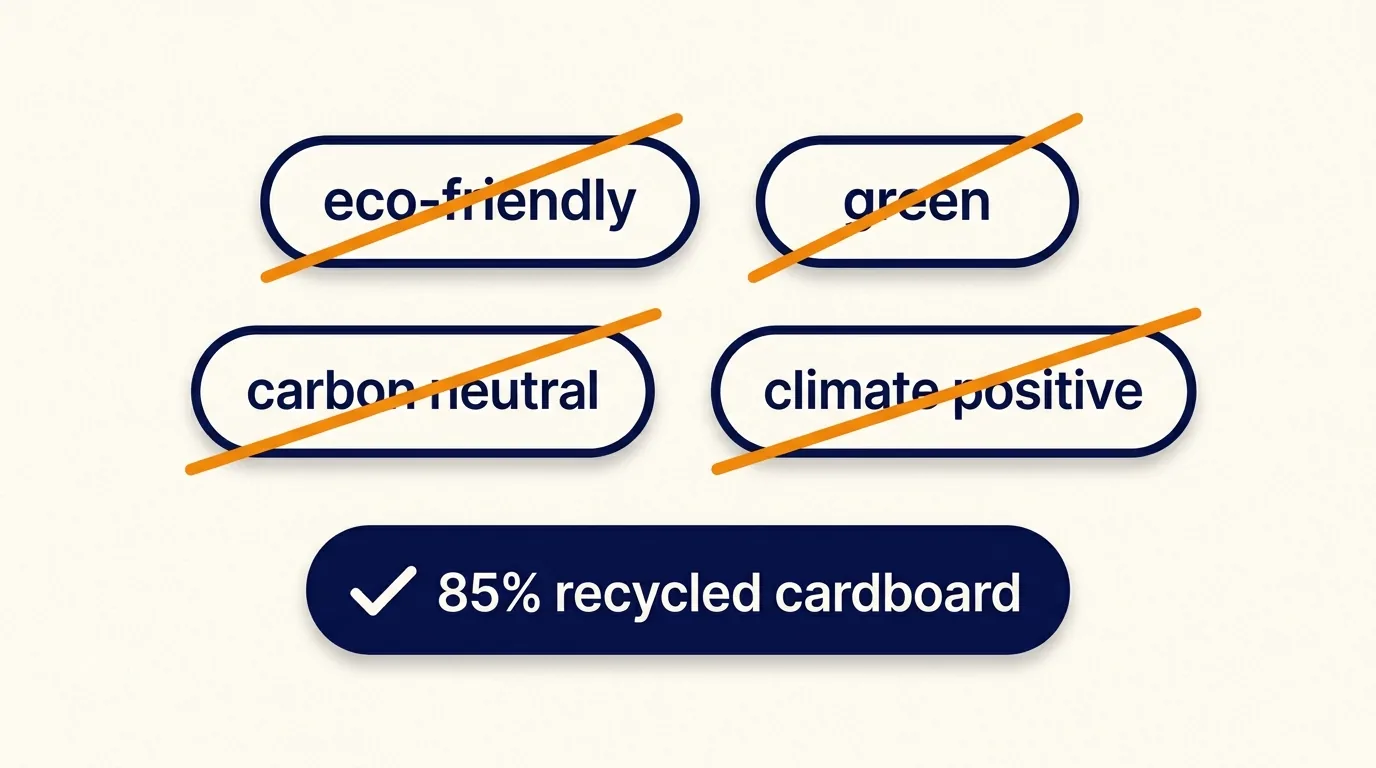
Notice the pattern in that last row. Specific, verifiable, honest claims remain legal. EmpCo does not ban green marketing. It bans green vagueness. A company that actually reduced packaging emissions by 40% can say exactly that, with the evidence to back it up, and will now stand out against competitors who can no longer say anything fluffy at all.
That is worth repeating to nervous stakeholders: for companies with real environmental work behind them, EmpCo is a competitive advantage.
Rewrites that survive EmpCo
The fastest way to get a feel for the new rules is to see the same claim before and after:
- “Eco-friendly packaging” becomes “Packaging made from 85% recycled cardboard, recyclable in all EU paper streams.”
- “Carbon neutral delivery” becomes “Delivered by electric vehicles in 12 cities. For other routes we report actual emissions per order.”
- “Our sustainable collection” becomes “This collection uses GOTS-certified organic cotton” with the certificate one click away.
Same products, same environmental work. The difference is that every rewritten claim is specific, checkable and honest about its limits. If a claim cannot be rewritten this way, EmpCo’s answer is that it should not be made at all.
How is EmpCo different from the Green Claims Directive?
Short answer: EmpCo is law, the Green Claims Directive never made it. The two started as a package. EmpCo bans the worst practices; the Green Claims Directive would have added detailed substantiation rules and pre-approval of claims by independent verifiers. After heavy political pushback, the European Commission withdrew the Green Claims proposal in 2025.
Plenty of 2024-era articles still describe both as incoming law, which causes real confusion in planning meetings. For your 2026 roadmap only EmpCo matters, and waiting for the other shoe to drop is not a strategy. The shoe was withdrawn.
What are the penalties for getting it wrong?
Penalties are set per country, because EmpCo works through national consumer law. Expect the usual toolkit: orders to pull campaigns, fines, and public naming by the regulator. For widespread infringements that affect consumers in multiple member states, EU consumer protection rules let fines reach at least 4% of a trader’s annual turnover.
The more immediate risk for most brands is not the fine. It is the complaint. Consumer organisations and competitors can report violations from day one, and greenwashing complaints make excellent press. One flagged claim can cost more in reputation than a regulator would ever charge.
How do marketing teams prepare before 27 September 2026?
You cannot fix what you have not found. Every serious EmpCo project starts as an inventory problem and ends as a process problem. The playbook:
- Inventory every environmental claim you have live. Not just campaigns. Product pages, category texts, packaging copy, old blog posts, PDFs, app store descriptions, marketplace listings. This is the step teams underestimate by an order of magnitude.
- Triage the generic terms. Search for “green”, “eco”, “natural”, “sustainable”, “climate”, “conscious” and their local-language variants across all markets. Each hit either gets specified, substantiated or deleted.
- Kill offset-based neutrality claims. Rewrite them around what you actually did in your value chain. “Carbon neutral” becomes “we cut production emissions by 40% since 2020”, with the data behind it.
- Check every label and badge. Anything self-invented goes. Anything certified needs the certificate on file and linked.
- Put a gate in front of new content. Cleaning up once means nothing if next quarter’s campaign reintroduces the same claims. Every new asset needs a compliance check before it ships, at the speed marketing actually works.
Steps 1 and 2 are exactly what bulk content auditing exists for. Scanning every live asset against a policy like EmpCo is what Typetone’s marketing compliance platform does in hours instead of quarters, and our EmpCo Directive policy page shows how the directive’s rules translate into automated checks. Step 5 is a workflow question as much as a tooling one; approval flows with a human reviewer making the final call keep legal comfortable without turning every social post into a two-week project.
However you run it, start with the inventory now. September lands in the middle of Q4 campaign planning, and the teams that treat EmpCo as a September problem will be doing claim cleanup during their busiest quarter of the year.
The bigger picture: green claims are just the start
EmpCo fits a pattern. The EU regulated financial promotions, then crypto marketing, and now environmental claims. Each time, the direction is the same: marketing statements need evidence behind them, and the burden of proof sits with the company making the claim.
The European Commission’s overview of sustainable consumption rules makes clear this is a long-term agenda, with durability labelling and right-to-repair rules following the same track. Treating each new directive as a one-off scramble does not scale. Treating claims as data, checked continuously against whatever policies apply to you, does.
That is the real lesson of EmpCo for marketing teams. The green claims cleanup is this year’s project. Content that can survive an audit is the permanent goal.
 Data privacy safe